Femoroacetabular Impingement Treatment and Hip Joint Care in Bangalore
Femoroacetabular impingement (FAI) is a condition in which the bones of the hip joint have an abnormal shape or contact that can cause pain and restrict movement. Symptoms may include hip or groin pain, stiffness and discomfort during activities such as bending, squatting or sports. Dr. Raghavendra Kembhavi provides orthopaedic evaluation for hip conditions and can discuss appropriate treatment options based on the diagnosis and severity of symptoms. If you are looking for femoroacetabular impingement treatment in Bangalore, arrange a consultation to understand the available options.
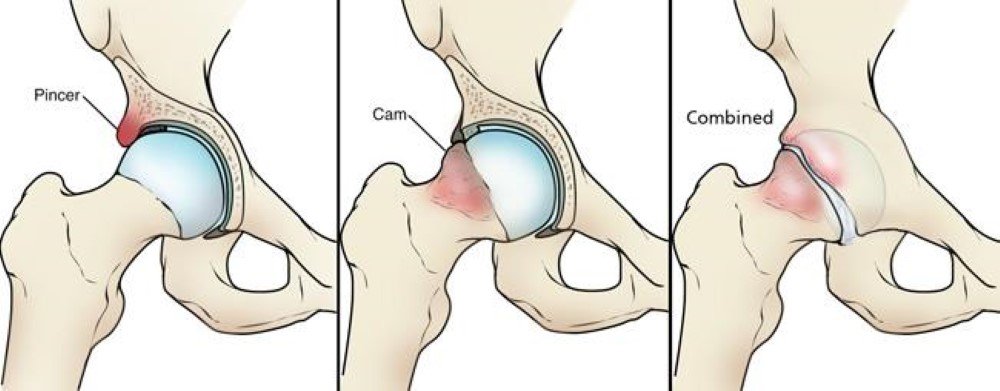
There are two main types of FAI — Cam impingement and Pincer impingement — and many patients have a combination of both, known as mixed impingement. In Cam impingement, an abnormal bony bump at the femoral head-neck junction jams into the socket during hip flexion. In Pincer impingement, the socket over-covers the femoral head, pinching the labrum between the rim and the ball.
Over time, this repeated abnormal contact tears the labrum and wears down the articular cartilage. Activities involving deep hip flexion — squatting, sitting for long periods, or sports with quick direction changes — typically aggravate the pain. Diagnosis is confirmed with specialised X-ray views, MRI/MR arthrography, and where required a 3D CT scan, following a clinical examination that includes the FADIR impingement test.
Signs and Symptoms
FAI usually develops gradually and is often mistaken for a groin strain. Symptoms commonly include:
Groin Pain
A deep, aching pain in the groin — the earliest and most common symptom of FAI.
Pain With Deep Hip Flexion
Discomfort when squatting, sitting cross-legged, or getting in and out of a car.
Clicking or Catching
A sensation of clicking, popping, or catching inside the hip joint during movement.
Stiffness and Reduced Range of Movement
Joints feel tight and don’t move as freely as they should, especially internal rotation.
Diagnosis
Following a detailed history and clinical examination by a hip preservation surgeon — including the FADIR impingement test (Flexion, Adduction, Internal Rotation) — imaging is required to confirm the diagnosis.
Non-surgical treatment
Conservative management may help in mild cases and includes activity modification, targeted physiotherapy to strengthen hip stabilisers and gluteal muscles, short-term NSAIDs, and image-guided intra-articular corticosteroid or hyaluronic acid injections. These measures relieve symptoms but do not correct the underlying bony abnormality.
Surgical Treatment
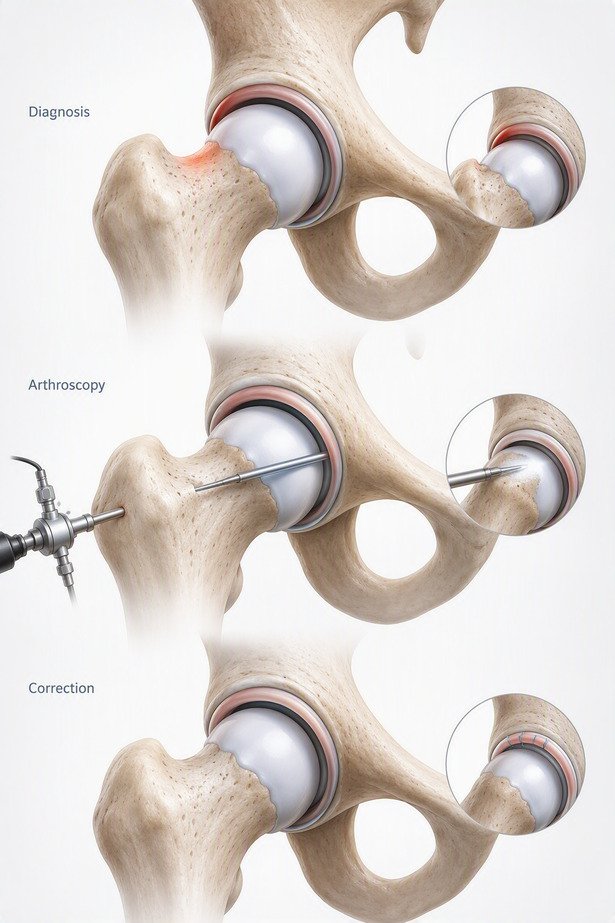
When conservative measures fail and symptoms persist — particularly where there is a labral tear or mechanical catching — hip arthroscopy is the gold-standard treatment for FAI. It is a minimally invasive keyhole procedure with faster recovery, less pain, and better outcomes than open surgery.
Femoral osteoplasty
Reshaping the cam bump at the femoral head-neck junction so the ball can move freely within the socket without impinging.
Acetabular rim trimming and labral repair
Removing excess bone from the socket rim in pincer impingement and repairing or reconstructing the torn labrum with suture anchors to restore the seal and stability of the joint.
Our expert Dr Raghavendra Kembhavi, being a hip arthroscopy surgeon and hip preservation specialist, is known for treating complex FAI and labral pathology with excellent outcomes — addressing impingement, labral tears and associated cartilage damage in a single arthroscopic procedure.
What to expect after surgery
This will vary depending on the procedure performed and the preferences of the treating hip preservation surgeon.
Following FAI surgery, crutches are typically used for the first one to two weeks with progressive weight-bearing. Physiotherapy begins early to restore range of movement, followed by a graduated strengthening and hydrotherapy programme. Return to sport and high-impact activity is usually possible between three and four months, guided by rehabilitation progress.