Scapular Dyskinesis Treatment in Bangalore
If your shoulder blade sits unevenly, wings out at the back, or moves awkwardly when you raise your arm, you may have scapular dyskinesis. It’s not a disease on its own — it’s a movement pattern that signals something in your shoulder isn’t working as it should.
Scapular dyskinesis is common in people with shoulder pain, and it’s often both a cause and a consequence of problems like rotator cuff injuries, impingement, or labral tears. At our clinic in Bangalore, Dr. Raghavendra Kembhavi takes a whole-shoulder approach — because treating the scapula is often the key to resolving shoulder pain for good.
What is scapular dyskinesis, and why does it matter?
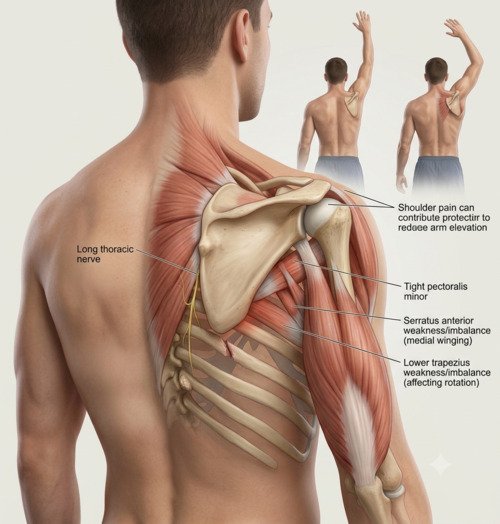
The scapula (shoulder blade) sits on the back of the rib cage and provides a stable base for every shoulder movement. When you raise your arm, the scapula needs to rotate upward, tilt backward, and stay close to the rib cage. If any of these movements are off, the shoulder loses its stable foundation.
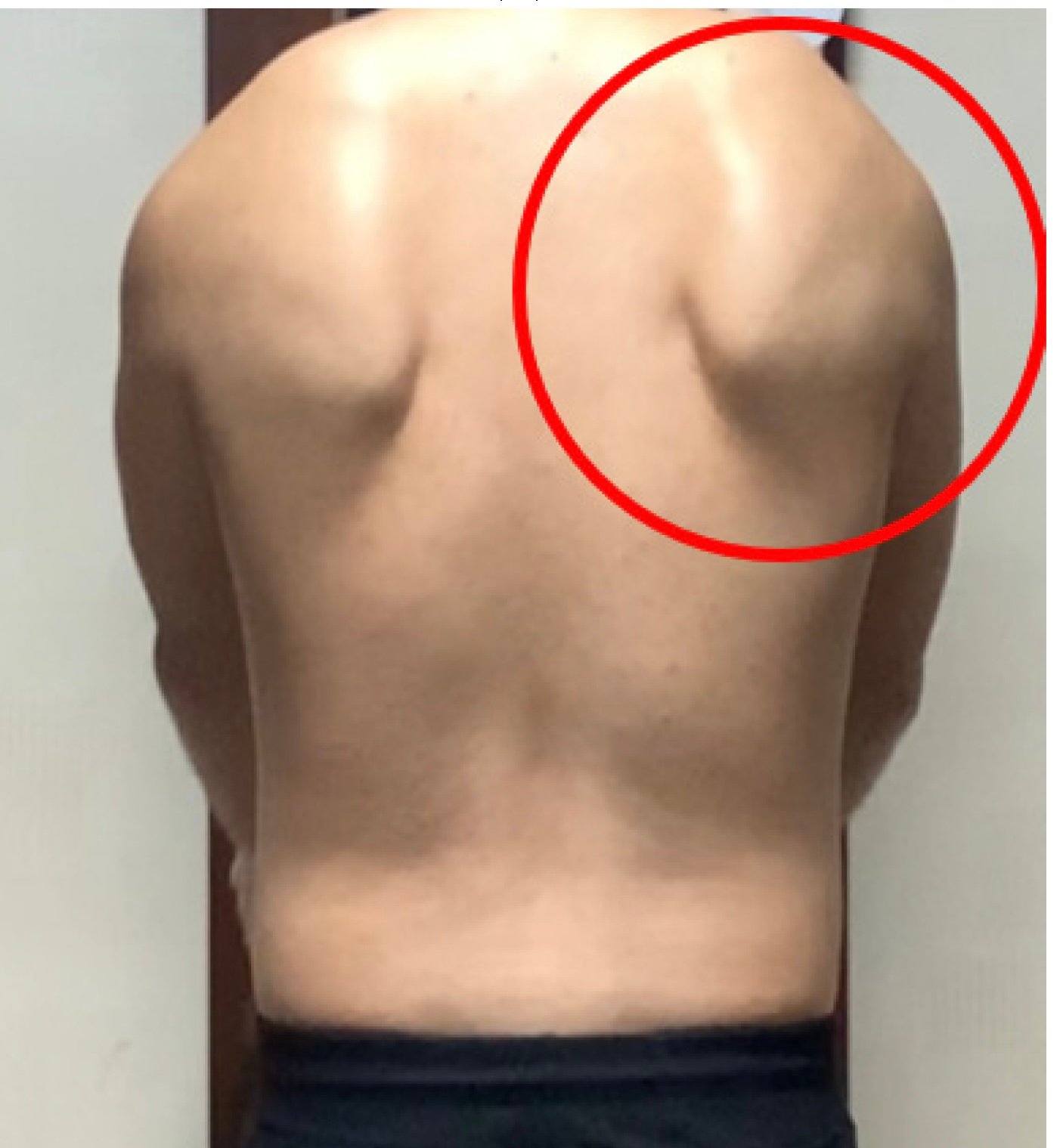
Scapular dyskinesis is the term for these abnormal movement patterns. It can involve the scapula winging out (prominent medial border), sitting too high or low, or failing to rotate properly with arm elevation. The causes are varied — muscle weakness or imbalance (especially the serratus anterior and lower trapezius), tightness of the pectoralis minor, nerve injuries like long thoracic nerve palsy, or simply a consequence of shoulder pain itself.
What matters is that scapular dyskinesis rarely exists in isolation. It’s usually part of a bigger picture — and treating it is often the missing piece in resolving stubborn shoulder problems.
Signs and symptoms
Scapular dyskinesis can be visible, but it’s not always obvious. Some people only discover it when their shoulder pain doesn’t improve with standard treatment.
Visible winging
The inner border of the shoulder blade sticks out, especially when pushing against a wall or reaching forward.
Asymmetry between sides
One shoulder blade sits higher, lower, or more prominent than the other — a common clue on visual inspection.
Shoulder pain with overhead movement
Discomfort or weakness reaching overhead. The scapula may not rotate upward properly, causing impingement.
Fatigue and rapid tiring
The stabilising muscles tire quickly, and symptoms worsen with prolonged activity or repetitive overhead work.
Diagnosis
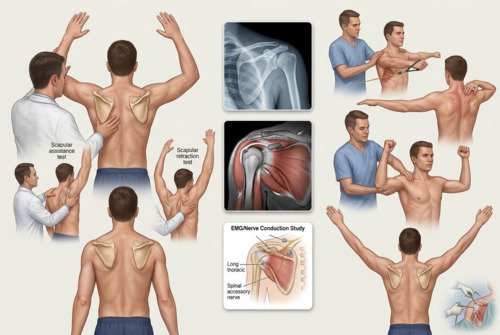
Scapular dyskinesis is diagnosed through clinical observation and specific tests. Dr. Kembhavi watches your scapular movement as you raise and lower your arms, looking for winging, asymmetry, or early elevation. The “scapular assistance test” and “scapular retraction test” help identify whether scapular correction reduces your symptoms — a positive test is a strong indicator that dyskinesis is contributing to your pain.
Imaging and additional tests
Imaging is used to rule out underlying causes. X-rays can show bony abnormalities or arthritis. An MRI may be needed if a rotator cuff tear, labral injury, or nerve problem is suspected — particularly if there’s significant winging or weakness. In rare cases, nerve conduction studies are used to assess for long thoracic or spinal accessory nerve palsy.
Treatment approach
Scapular dyskinesis is almost always treated with physiotherapy — the goal is to strengthen the stabilising muscles (serratus anterior, lower trapezius), stretch tight structures (pectoralis minor), and restore normal movement patterns. Most patients improve significantly with 6–12 weeks of targeted rehabilitation. Surgery is only considered when there’s an underlying structural problem that needs correcting.
How scapular dyskinesis is treated
Step 1
Assessment & Postural Correction
Detailed analysis of your scapular movement patterns. Postural education to correct daily habits that contribute to dyskinesis.
Step 2
Targeted Physiotherapy
Strengthening the serratus anterior, lower trapezius, and rotator cuff. Stretching the pectoralis minor and other tight structures.
Step 3
Addressing Underlying Causes
Treating co-existing shoulder problems — rotator cuff injury, impingement, or labral tear — that may be driving the dyskinesis.
Step 4
Progressive Loading
Gradual progression from basic exercises to more advanced strengthening, with functional movement retraining.
Step 5
Sport-Specific Training
For athletes, a transition to sport-specific drills that challenge scapular control under fatigue and speed.
Step 6
Long-Term Maintenance
Ongoing home exercises and posture awareness to maintain scapular control and prevent recurrence.
Physiotherapy-first vs. surgical approach
| Factor | Physiotherapy-First | Surgical Approach |
|---|---|---|
| Best for | Most cases; muscle imbalance or postural causes | Underlying structural problem (torn tendon, nerve palsy) |
| Pain relief | Gradual; improves with muscle retraining | Addresses the structural cause directly |
| Recovery time | 6–12 weeks of guided rehabilitation | Sling 4–6 weeks; full recovery 3–6 months |
| Recurrence risk | Low with ongoing maintenance exercises | Depends on the underlying condition |
Why choose Dr. Raghavendra Kembhavi
Whole-shoulder approach
Scapular dyskinesis rarely exists on its own. Dr. Kembhavi assesses the entire shoulder — rotator cuff, labrum, and scapular mechanics — to identify and treat the full picture, not just the visible movement problem.
Physiotherapy-first philosophy
Most cases of scapular dyskinesis respond to targeted rehabilitation. Dr. Kembhavi emphasises conservative care before considering surgery, working closely with physiotherapists to ensure a structured programme.
Accurate diagnosis
Not all shoulder blade asymmetry is significant. Dr. Kembhavi uses specific clinical tests — including the scapular assistance and retraction tests — to determine whether dyskinesis is truly contributing to your symptoms.
Personalised rehabilitation
Every patient’s movement pattern is different. Dr. Kembhavi works with physiotherapists to design a programme that targets your specific deficits — not a one-size-fits-all protocol.
Recovery timeline with physiotherapy
Recovery is measured in weeks, not days. Consistency with your home exercises is the biggest predictor of success.
Week 0–2: Re-education
Learning to activate the right muscles. Low-load exercises for serratus anterior and lower trapezius. Postural correction begins.
Week 2–6: Strengthening
Progressive loading of the stabilising muscles. Movement patterns begin to normalise. Light overhead activity resumes.
Week 6–12: Functional Training
Advanced strengthening and functional movement retraining. Return to sport-specific activity under supervision.
Month 3+: Maintenance
Full return to activity. Ongoing home programme to maintain scapular control and prevent recurrence.